What international law says about disruption in the Strait of Hormuz By Ryan Gozy
The Strait of Hormuz has been severely disrupted for over six months now. Shipping trackers have found that the maritime traffic in the strait still remains at a fraction of what is typical. The strait acts as a vital shipping port for oil, and Iran closed it in response to American and Israeli missile strikes in February that killed many of their top officials.
Both the United States and Iran have made conflicting claims over the strait, with the Islamic Revolutionary Guard Corps (IRGC), the primary military force of Iran, claiming that it will remain closed until certain demands are met. President Trump has claimed complete U.S. control over the vital waterway. With about a quarter of the world’s seaborne oil trade typically moving through the strait, Hormuz will remain a major point of contention until maritime traffic resumes to normal levels. This conflict raises important issues on the topic of maritime and international law, most notably regarding the extent of Iran’s control over the strait as well as the legal basis of the United States’ repeated ambitions to take full control of the strait and charge fees to passing ships.
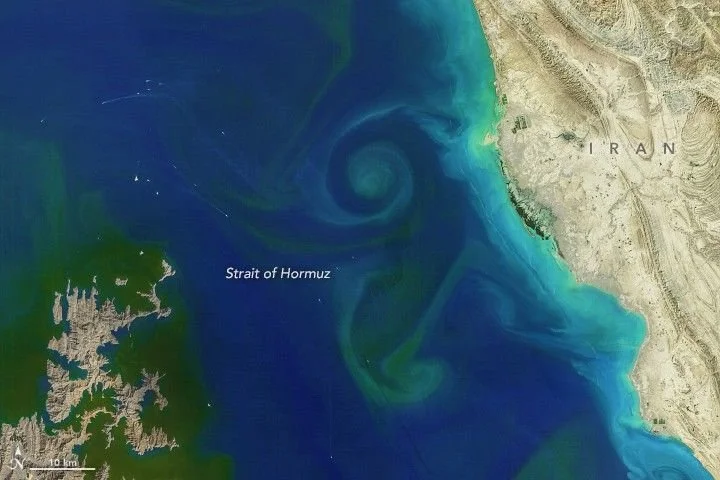
Photo by NASA
Two areas of law are important to understanding the control, or lack thereof, that Iran and the U.S. have over the Strait of Hormuz: treaty-based maritime law, as well as customary international law. When exploring treaties crucial to understanding state control over waterways, the United Nations’ Convention on the Law of the Sea provides clear rules for the duties of states bordering a strait, as well as the general control a state has over a waterway. Firstly, this convention defines the territorial sea of a state as anything up to 12 nautical miles of a state’s land. This means that, any part of a waterway beyond 12 nautical miles, a state has limited control over. At its narrowest point, the strait of Hormuz is roughly 30 nautical miles wide, which does not give Iran control over the entire strait according to this doctrine. Moreover, the convention has a specific section regarding straits, barring member states from suspending transit passage through a strait.
While these conventional provisions would clearly put Iran in violation of international law, it is important to understand the nature of international law. Because international law lacks a clear enforcement mechanism, such as a unilateral world government that is recognized by every state, international treaties such as the aforementioned convention only apply to states that ratify the agreement. Both Iran and the United States have not ratified the UN convention on the Law of the Sea, meaning that neither are legally bound by its provisions. Both states have, however, signed the 1958 Geneva Convention on the Territorial Sea and the Contiguous Zone (though Iran has never ratified it), which allows states to restrict passage through a strait if it is not innocent. Under this convention, passages considered not innocent are ones which violate the peace, good order, or security of the state. Under this convention, Iran has some legal standing to restrict access through Hormuz, though one must still analyze the role of Oman, a state which also borders the strait and therefore shares legal control with Iran. The two states signed a treaty in 1974, which divided the waterway and control over each between them, meaning that Oman and Iran should have equal legal authority in controlling Hormuz. Such treaty-based considerations limit the legal power that Iran has over closing the strait of Hormuz as it has for months now, especially without Oman’s cooperation.
Treaty-based international law is only one consideration when exploring the legality of Iran and the United States’ attempts to control Hormuz. The second area of international law, known as customary law, plays a role as well. For a practice to be considered customary international law, it must be a general practice by states, and must be followed in accordance to opinio juris, where a state follows the general practice because they believe it to be an obligation. Because customary law does not rely on any specific treaty as a reference to its legitimacy, customary law can often be contested, as is the case currently concerning Hormuz. The United States currently argues that customary law allows the safe transit passage of ships, which they believe is a custom Iran is currently violating. Iran, in contrast, only accepts the principle of innocent passage, which gives them considerably more leverage in restricting access through Hormuz. Customary law, as a system, offers exemptions for states which are adamantly opposed to a custom as it is being proposed, which is known as the persistent objector rule and allows a rule to be nonbinding on opposing states when it becomes established. This would likely apply for Iran, which has consistently opposed the customary rule of transit passage during its formation. Most other customary laws which could be applied to the strait of Hormuz situation do not justify Iran’s actions, however. Customs may give Iran some ability to restrict enemy vessels from entering the strait, but a total closure that Iran has attempted, without safe passageway for neutral vessels, is not given strong protections in international customary law. Because of this, Iran would only be legally permitted to restrict the access of the United States and Israel under international customary law.
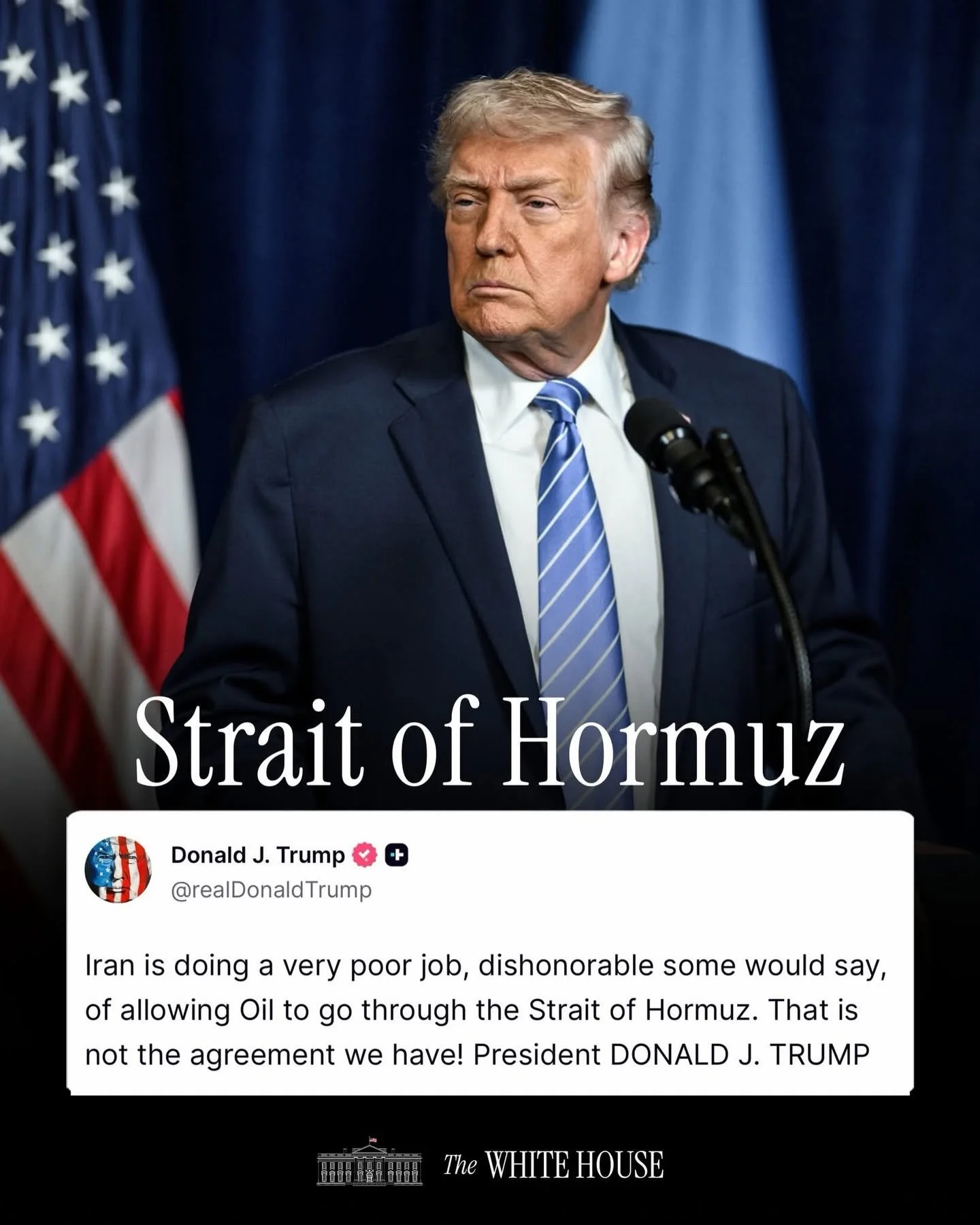
Photo from President Trump
What legal justifications does international law provide for the United States to control the Strait of Hormuz, as the Trump administration has repeatedly claimed to be doing? The short answer: very little to no justification at all. The UN Convention grants territorial claims to bordering states only, giving the U.S. no legal basis here to make a sovereign claim over Hormuz. Customary law follows similar principles in relation to this. Moreover, the UN Charter, which the U.S. is a signatory of, stops member states from using force to challenge the territorial integrity of a state. President Trump’s claims of “total control” over Hormuz would appear in violation of the sovereignty of both Iran and Oman, as the water within the strait remains a part of their sovereign territory, making such claims a potential violation of international law. International law does give the U.S. legal justification in exerting significant influence in the travel through Hormuz, but mere influence does not necessarily take territorial rights away from Iran. Whether the statements made by the Trump administration reflect real ambitions remains to be seen, though it is clear that there would not be a legal basis for territorial acquisition of Hormuz, especially by force.
When analyzing both treaties and customs related to maritime international law, it is apparent that both Iran and the United States’ claims and actions related to the Strait of Hormuz can be disputed. This, however, may have little meaning in practice. International law is often not adhered to, with studies finding little effectiveness in treaties outside of trade and finance. Moreover the U.S. is widely known for not signing major international treaties, giving them the ability to simply claim that specific international laws do not apply to them, and the UN convention in question here is no exception. Customary law provides fewer enforcement mechanisms to ensure states abide by them. Because of the lack of a world government, international law only works when states decide to cooperate, and militarily powerful states like the U.S. and Iran will not always be challenged for not following international law. As a result, both countries will likely continue with their ambitions, even if they are not in accordance with international laws.
Ryan Gozy is a Political Science student at Utica University